
As the country tries to put COVID-19 behind it, what employees look for in employers is changing – with mental health support and socialising opportunities particularly in demand.
With companies being hit by both ‘the great resignation’ and a lack of candidates for available roles, it’s never been more important for businesses to be aware of hiring trends.
Now, a new survey reveals which perks employees are looking for in a new role, and which are sliding down the priority scale.
The impact of the pandemic is reflected in two different ways – with mental health support and socialising opportunities being amongst the key perks that potential employees want.
Here, we examine the survey findings and take a look at some interesting regional, gender and age differences.
What were the key findings of the survey?
Unsurprisingly, the survey – which was conducted by workspace facilitator Reef and asked 1,000 office-based workers which perks were most appealing when looking for a new role – found that new ways of working was the most sought after perk.
Flexible working was picked out by 47% of respondents, with hybrid working identified by a further 41%.
The survey also pinpointed the increasing importance potential employees are placing on mental health support, with 19% saying this was important to them.
On the other hand, many respondents were eager to put the pandemic in the rearview mirror and were attracted by socialising opportunities.
Drinks hour on a Friday was particularly attractive (chosen by 21% of respondents), while that old favourite the office Christmas party continues to appeal (17% of respondents).
What else did the survey show?
The following infographic from Reef shows more survey findings, and breaks selected questions down by age, location and gender.
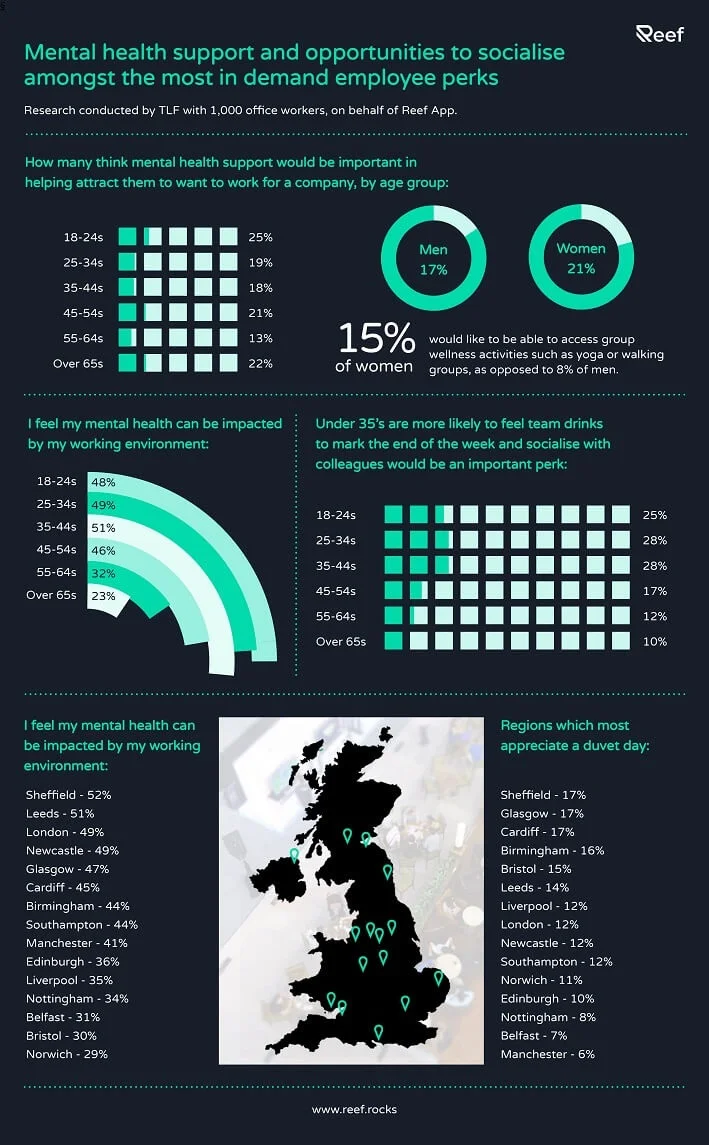
Some of the most interesting disparities are by age group.
For example, 25% of 18-24 year olds consider mental health support an important perk, compared to just 13% of 55-64 year olds.
Similarly, Friday drinks was prized by 28% of respondents in the 25-34 and 25-44 groups (as well as 25% of 18-24s), but was only attractive to 12% of 55-64s and 10% of over 65s.
And, when asked if they think their mental health is impacted by their working environment:
Around half of under 54s (between 46% of 45-54s and 51% of 35-44s) answered yes, compared to only 32% of 55-64s and 23% of over 65s.
By location, Sheffield led the way in this metric (with 52% of respondents saying that their mental health is impacted by their working environment). Leeds (51%), London (49%) and Newcastle (49%) also scored highly, while Belfast (31%), Bristol (30%) and Norwich (29%) generated the lowest scores.
Exploring this phenomenon in more detail, Reef founder James Coughlan points out that, according to the research, “one in 10 (10%) feel their mental health is negatively impacted by working full time in an office, whereas one in 14 (7%) say working at home has a negative impact on them.”
In short, flexibility is key.
What can we learn from these survey results?
Commenting on the survey findings, Cary Cooper, a professor of organisational psychology at the University of Manchester, said:
“A genuine focus on wellbeing and psychological support is going to be key if businesses want to attract and retain the best staff going forward.
“It can’t just be lip service or things like sushi being delivered to your desk, which are nice to have but don’t make a real difference to an employee’s quality of life.
“As with most things, much of what will be right for individuals is down to personal preference and also what life stage they are at, but it’s clear from the Reef App research that mental health and wellbeing support is so important.
Flexibility of when and where people work, along with a recognition that people have a life outside of the workplace, is vital.”
Where can I get more hiring advice?
To go deeper into this topic, check out the Startups guide to recruiting in a hiring crisis, full of expert advice on what potential employees are looking for in new roles, and how you can make your business stand out from the rest.


