
We breakdown the best takeaway POS systems out there for small businesses by comparing strengths, weaknesses and what they will cost you.
Startups.co.uk is reader supported – we may earn a commission from our recommendations, at no extra cost to you and without impacting our editorial impartiality.
We assessed 11 POS systems across 37 subcategories, from pricing to kitchen display systems, and found that Square is the best POS system for takeawaysthanks to unmatched usability, and excellent mobile and QR code ordering capabilities.
Choosing the best takeaway POS system for your business can be more nuanced than just looking for the best POS for restaurants. You’ll need a system that can handle online ordering while remaining fast and intuitive to use, so we’ve broken down the top options and what they can do for your business.
The best POS systems for takeaways: quick comparison
|
Best for
|
Overall Score
Based on our in-depth research and user testing
|
Pricing from
|
Key benefits
|
|
|---|---|---|---|---|
|
BEST OVERALL

|

|

|

|

|
|
Best overall takeaway POS system |
Professional grade terminals to make managing takeaways easy |
Speedy ordering at smaller takeaways |
Takeaways with very high-volume orders |
Excellent loyalty tools to encourage repeat orders |
|
4.8
|
4.4
|
4.3
|
4.0
|
3.9
|
|
Free (1.75% transaction fees) |
£9.99/month (includes device) |
Pay-as-you-go (1.69% transaction fees) |
£80/month |
£79/month |
|
|
|
|
|
I check this article regularly to keep it up to date. I’ve verified that all the pricing and information here is correct as of this date. However, given the rapidly changing nature of the payment processing industry, I always recommend confirming prices directly with the POS provider before making a buying decision.
To determine our ranking of the best takeaway POS systems we tested 11 top providers, amounting to a total of 455 hours of investigation, including new hands on testing in May 2026.
Our independent testing process is based around the six core categories which are most important to small business owners in 2026: software depth (35%), hardware options (20%), ease of use (20%), help and support (10%), cost (10%) and brand reputation (5%).
You can find a full breakdown of our testing process in the complete methodology section at the end of the review.
What are the essential takeaway POS terms you need to know?
A KDS is a digital order screen that allows for seamless communication between the front-of-house and the kitchen staff. It’s a critical tool for takeaway businesses as it ensures all orders from your main till, your website and through delivery apps are funneled into your kitchen.
A delivery aggregator is a third-party app that connects your takeaway business with delivery platforms, like Uber Eats and Deliveroo.
1. Square: best overall takeaway POS system
Overall rating: 4.8
Monthly pricing from: free
In-person transaction fee: 1.75% (UK cards)
Online transaction fee: 1.4% + 25p (UK cards)
KDS integration: Square provides its own first-party KDS which is available for £15 + VAT per device, per month
Square is the best POS for takeaways thanks to the excellent ease-of-use provided by the extremely well designed user interface, combined with the no-cost plan and overall depth of features.
Takeaway businesses often find themselves short staffed, with high order volumes, so having a fast and intuitive system is paramount: Square led the pack in our latest hands-on testing by completing our complex food and drink order simulation in just 8.7 minutes, much faster than the average completion time of 18 minutes.
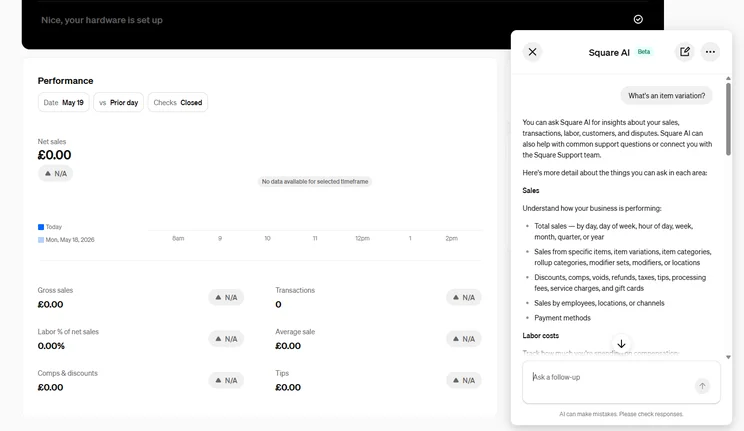
Square’s feature-rich software makes things easy for takeaway owners via the built-in menu synchronisation for a unified workflow, which means your staff won’t be struggling with multiple disconnected tablets during a rush order.
You can also seamlessly connect your POS to Square Online for free, so you can rapidly launch a mobile-ready web page for online orders, with the option for delivery or pickup.
Do I need additional hardware?
Square can be run solely from an iPad just by downloading the free app, which can help keep overhead costs down and prevent you from being locked into hardware you may not need down the line.
If you do want more sophisticated hardware, Square provides an impressive range of terminals and accessories like:
- Square Kiosk (£99 + VAT): this is an iPad-driven self-service device that can free up your staff and let customers order for themselves (Square Kiosk app is required, which is £35 + VAT per month)
- Square Stand (£99 + VAT): used to turn your iPad into a countertop terminal
- Square Register (£699 + VAT): a sophisticated, dual-screen till system
- Square Terminal (£149 + VAT): a handheld POS terminal which I’ve personally tested, and found it be excellent to use
Can Square integrate with delivery platforms?
Square can seamlessly integrate with third-party booking applications, connecting to hospitality engines like Resy OS, Eat App, and WOWAPPS.
Square uses delivery aggregators like Deliverect, HubRise and Cuboh in order to synchronise with the major ordering services like Deliveroo, Uber Eats and Just Eat.
- Square has unparalleled usability, with a very short learning curve.
- You can seamlessly integrate an online store through Square Online for free.
- Square has an impressive range of hardware and terminals to support scalability.
- Square offers no functionality for tracking ingredient usage in your meals.
- There's no detailed cost/profit management tools, which Clover provides.
- Square doesn't have a dedicated training mode to onboard staff, though the ease of use makes this less of an issue.
How much does Square cost?
| Pricing | |
| Software | Free plan: free Square for Restaurants Plus plan: £69/location/month Premium plan (for businesses that process more than £200,000/year): custom pricing |
| Hardware | Square Stand (to turn your iPad into a countertop terminal): £99 + VAT Square Terminal: £149 + VAT Square Kiosk (kiosk device using an iPad): £99 + VAT Square Register: £699 + VAT |
| Transaction fees | 1.75% for in-person card transactions 2.5% for Virtual Terminal and Square Invoices 1.4% + 25p for UK online transactions 2.5% + 25p for non-UK online transactions |
| Free trial? | Yes; 30-day free trial for Plus and Premium plans |
Square’s contract-free, pay-as-you-go plan has zero monthly costs and a fair 1.75% in-person transaction fee which is best suited to early-stage takeaways that need to avoid fixed, heavy monthly financial commitments.
Just note that for payments taken through Square Online, you’ll be paying 1.4% + 25p with each payment taken from a UK card online.
I love using Square, its layout is so simple and well designed, with both the front and back office equally easy to use. Everything felt modern and actions like sending orders to the kitchen were effortless Every step of the process is just so easy: from account setup to processing payments.

2. Clover: best premium terminals for rapid checkouts
Overall rating: 4.4
Monthly pricing from: £9.99 per month (includes device)
In-person transaction fee: quote-based
Online transaction fee: quote-based
KDS integration: Clover provides its own first-party KDS, which includes an additional fee for the hardware and monthly software fee
Clover is the best option for takeaway chains that are outgrowing basic tablets and require commercial-grade countertop terminals to rapidly manage intense order workflows. The Clover Countertop Duo is a sophisticated terminal which comes with a 14-inch touchscreen display and a highly customisable eight-inch customer display.
I tested the Clover countertop till myself and was impressed with how responsive the terminal was, which made processing orders and payments incredibly fast and easy. The standout element for me was the biometric fingerprint scanner, which meant I could get into the Clover POS platform faster than any other device.
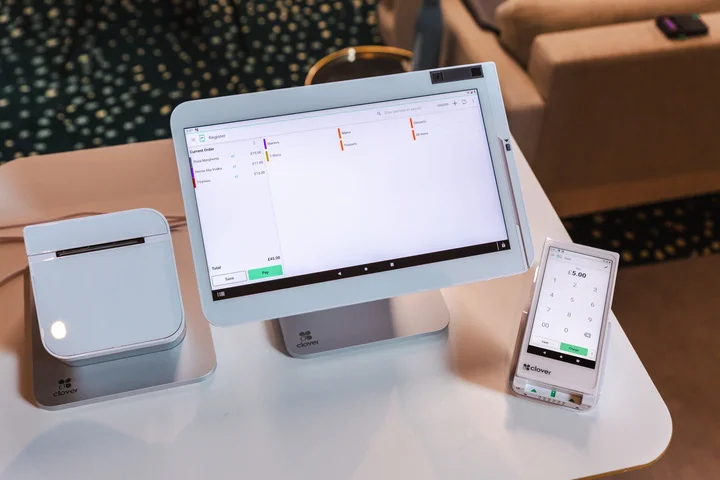
I found Clover’s software to be equally well designed in the frontend and back office. It also has great built-in tools to effectively manage takeaways and, in particular, reduce food waste, including:
- Advanced ingredient tracking (something our top choice Square is unable to support)
- Automated low-stock warnings
- Smooth kitchen display system routing, straight out of the box
When a customer places an online order, this will be sent directly to your first-party KDS, for an efficient ordering system.
Clover provides Clover Online Ordering as part of its POS offering, which auto-generates you a mobile-optimised ordering page that can either be hosted by your own custom domain or sub-hosted by Clover.
Do I need additional hardware?
Yes, a key aspect of Clover is that it can only be run through its own proprietary terminals, so you will not be able to run it separately through a tablet.
Clover has an exceptional range of POS hardware and accessories (pricing is quote-based) including:
- The Clover Flex: its portable POS machine with a built-in printer
- The Clover Flex Pocket: the slimmer version of the handheld device, which doesn’t include the printer
- The Clover Mini: a smaller countertop device with an eight-inch touchscreen
- The Clover Station Duo: the full countertop terminal, which includes the customer screen and fingerprint scanner
As Clover operates on a closed hardware ecosystem, just keep in mind you won’t be able to repurpose your terminals and accessories if you move to a different provider: Clover will be a long-term solution.
Can Clover integrate with delivery platforms?
Clover has a native partnership with Uber Eats, which is built-in directly to the dashboard in Clover Online Ordering.
For platforms outside of Uber Eats, such as Deliveroo, Clover relies on middleware applications via the extensive Clover App Market: including Deliverect, Otter and Stream.
Just note that these third-party apps will almost certainly require an additional monthly subscription cost, so it can become expensive for those with a modest delivery volume.
- Clover provides top of the range equipment and accessories.
- Clover provides bespoke transaction fees that are tailored to your business model.
- Clover offers round-the-clock phone and email support.
- Clover's equipment comes with steep upfront fees which will be a stumbling block for early-stage takeaways.
- Clover doesn't have a free plan like Square, requiring a contractual lock-in.
- Clover doesn't have automated tip sharing, unlike Toast and Square.
How much does Clover cost?
| Pricing | |
| Software | From £9.99 per month (includes device rental) |
| Hardware | Clover Flex: £15/month Clover Flex Pocket: £15/month Clover Mini: £20/month Clover Station Duo: £30/month |
| Transaction fees | Quote-based |
| Free trial? | No |
Our research shows Clover’s contracts can typically run between 12 and 48 months, with steep upfront equipment fees which won’t be suitable for many modest takeaway’s taking in less than £5,000 per month in card transactions (try Square or SumUp instead).
While Clover is more suited to high-volume, scaling takeaways, just note it is currently running a promotion where you can get a device and tailored transaction fees on a short-term contract for £9.99 per month.
I was really impressed by how sleek and responsive the Clover terminal was when I was testing it. It felt really well designed, meaning I was able to effortlessly complete tasks like adding items and amending orders, especially thanks to the clear, oversized buttons.
3. SumUp: best for small takeaway counters
Overall rating: 4.2
Monthly pricing from: free
In-person transaction fee: 1.69%
Online transaction fee: 2.5%
KDS integration: SumUp has a first-party system which can be run via iPad, though you must subscribe to the SumUp POS Pro tier (£49 + VAT per month) and the KDS costs £19 + VAT per screen, per month
SumUp is the best choice for smaller, independent, solo takeaway operators, thanks to the low transactions fees, simplicity of the software and affordable equipment.
SumUp has a minimalist user interface, with a short learning curve, that can still effectively manage basic product cataloguing, digital invoicing and sending out SMS receipts to customers. We found that the streamlined SumUp app is best for a simple checkout experience.
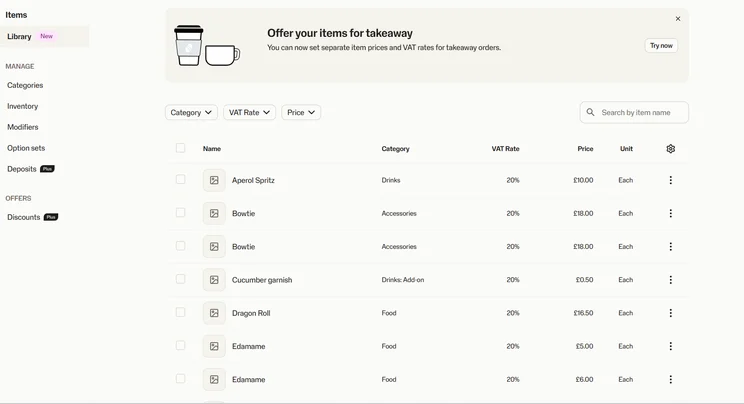
You’ll also be able to build an online webstore for free with the SumUp Online Store, which is a no-code way for takeaway owners to quickly launch a mobile-optimised website. There’s also SumUp Order and Pay, allowing guests to order directly from their phone.
For solo traders who need additional assistance, SumUp provides responsive chat support and phone help, available during regular business hours. Just note that 24/7 support is only available through a premium tier like Payments Plus or POS Pro.
Do I need additional hardware?
Unlike a locked ecosystem like Clover, SumUp’s POS can run entirely from an iPad just using the free app. This is a cost-effective approach for new takeaway businesses who don’t want to lock themselves into expensive proprietary hardware.
That said, SumUp does provide a solid range of terminals and accessories if you want to upgrade to a more professional setup:
- The Solo Lite (£25 + VAT) is a basic card reader that pairs with your phone
- The Solo (£79 + VAT) is a standalone reader from which you can access sales reports
- The SumUp Terminal (£135 + VAT) is a handheld POS device with dual Wi-Fi and a free SIM card
- The SumUp Register (£399 +VAT) is a countertop dual-screen full till system
- SumUp Kiosk (£499) is a self-service option to free up your staff
Can SumUp integrate with delivery platforms?
If you’re using the free version of SumUp, to connect to platforms like Deliveroo, Uber Eats and Just Eat you’ll need to use an aggregator app like Deliverect or Otter, which involve an additional cost.
However, if you’re paying for SumUp POS Pro then you’ll have access to much deeper native multi-channel synchronisation and KDS routing directly from the platform itself.
- SumUp provides extremely low set transaction fees on the Payments Plus tier.
- SumUp provides solid built-in mobile ordering.
- SumUp includes loyalty tools to encourage repeat orders.
- SumUp is lacking more sophisticated features like native multi-station routing.
- SumUp's back office and reporting is far clunkier than the more streamlined frontend interface.
- With SumUp you are unable to customise your mobile/QR landing page.
How much does SumUp cost?
| Pricing | |
| Software | Free POS: free Payments Plus: £19/month POS Plus: £39/month Business Account Plus: £15/month Invoices Plus: £8/month |
| Hardware | Handheld Terminal: £135 + VAT Solo (standalone card reader): £79 + VAT SumUp Solo Lite: £25 + VAT SumUp Register: £399 + VAT Retail POS Kit: £649 |
| Transaction fees | 1.69% in-person transaction fee on Pay-as-You-Go plan 0.99% in-person transaction fee on Payments Plus plan Bespoke transaction fees for businesses that process £10,000 or more a month 1.69% for international/corporate/premium cards 2.5% for online payments |
| Free trial? | Yes; 7-day free trial with Payments Plus plan |
Unlike Clover or Toast, SumUp is a budget-friendly takeaway POS which provides a reasonable 1.69% transaction fee for its contract-free pay-as-you-go plan.
For businesses taking in more than £3,000 in card sales per month it will actually be worth paying for Payment Plus in order to unlock the 0.99% transaction fee.
With the free plan, early-stage businesses will be reassured that they’ll only pay when they earn, but just keep in mind if you need a KDS you’ll have to pay for the more expensive Pro tier.
The frontend of SumUp stood out as very simple and quick to manage. It might be basic, but it’s what I’d call a safe pair of hands. I really liked the addition of the “park order” function. This made it so easy to back into an order and change anything on the fly, if a customer changes their mind.
4. Toast: best for very high-volume takeaways
Overall rating: 4.1
Monthly pricing from: £80 + VAT per month
In-person transaction fee: quote-based
Online transaction fee: quote-based
KDS integration: Toast provides a first-party KDS built directly into its operating system, with additional costs for both the hardware and software
Toast is an advanced POS system that will be the best choice for complex takeaway businesses that need to manage complicated multi-channel ordering, with advanced features like deep cost management reporting and customisable loyalty programmes.
Toast is enterprise-level software that excels at managing orders from multiple online third-party delivery platforms, alongside your walk-in customers. Toast has been designed to funnel in online orders, third-party app orders and in-store orders into one real-time stream for a unified experience.
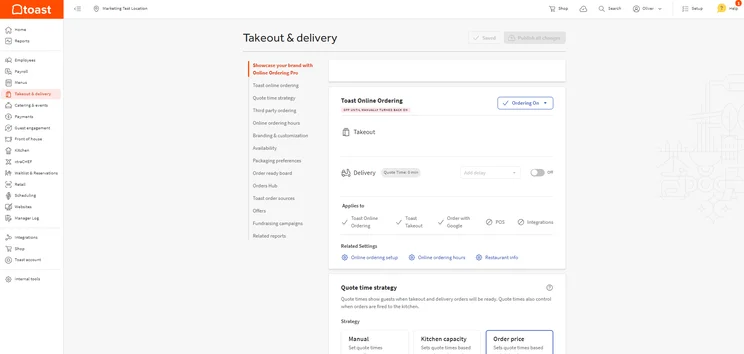
Despite its depth of functionality, our user testing found that Toast remains simple to use. One of the standout features was the search tool, which was extremely intuitive and allowed us to easily locate specific functions, with guided interactive walkthroughs to allow for fast training on the system.
Toast Online Ordering is an additional first-party module that handles your online orders, which costs extra, but you’ll benefit from having an auto-generated web front that’s connected to your main till for real-time menu syncing. There’s also the purpose-built Toast Local app, specifically for takeaway orders.
Do I need additional hardware?
While Toast can be run from a tablet, you should note that Toast is Android-exclusive, meaning that you won’t be able to run it from an iPad.
However, Toast does have a range of professional-grade hardware including its own purpose built countertop terminal, Toast Flex, which can seamlessly connect to the durable KDS.
The Toast Flex has a screen that can be flipped and adjustable height, making it highly adaptable to hectic, fast-paced takeaway environments. Toast’s hardware pricing is quote-based.
Can Toast integrate with delivery platforms?
Toast can integrate directly with the major delivery apps, like Uber Eats, and can also connect via third-party aggregators like Deliverect. Tickets from Uber Eats will be routed directly into your register and KDS.
- Toast's sophisticated software can support a busy kitchen, that also needs to provide takeaway orders.
- Toast's first-party kitchen display system can speed up production.
- Toast provides customisable online ordering.
- Toast lacks a contract-free plan and has a steep monthly operating costs.
- Toast is Android-only, so you won't be able to use any existing iPads you might have access to.
- Toast has a steeper learning curve than simple options like Square or SumUp.
How much does Toast cost?
| Pricing | |
| Software | Starter: from £80 + VAT per month Essentials: £150 + VAT per month Custom: custom pricing |
| Hardware | Quote-based |
| Transaction fees | Quote-based |
| Free trial? | No |
Toast comes with a steep price tag that will be overkill for many early-stage and modest takeaways. The key point to consider is that you’ll need to pay for at least the Essentials plan (£150 + VAT per month) in order to access the first-party KDS.
Keep in mind you’ll also need to pay for the hardware, as well as additional costs, such as third-party delivery aggregation, online ordering and loyalty tools. Toast also requires a contract, which typically lasts between one and three years.
The high setup and maintenance costs makes Toast a viable option for high-volume takeaways (taking in roughly £60,000 to £120,000+ in yearly card sales), but Square or SumUp will be the better choice for simple outfits.
5. Lightspeed Restaurant: best for encouraging repeat orders
Overall rating: 3.9
Monthly pricing from: £79 + VAT
In-person transaction fee: quote-based
Online transaction fee: quote-based
KDS integration: Lightspeed provides its own customisable first-party KDS, though there is an additional cost attached
Lightspeed is best for takeaways that want to build a loyal customer base, thanks to its exceptional customer engagement features, primarily through its add-on module Lightspeed Loyalty. This is a multi-tiered, sophisticated software, allowing you to create automated marketing campaigns using the drag-and-drop email builder.
Lightspeed is a premium option for takeaway owners, but you’ll benefit from the sophisticated features like deep data tracking. Lightspeed allows for precise, ingredient-level tracking, which will give you greater visibility over your spending and avoid wasted food costs.
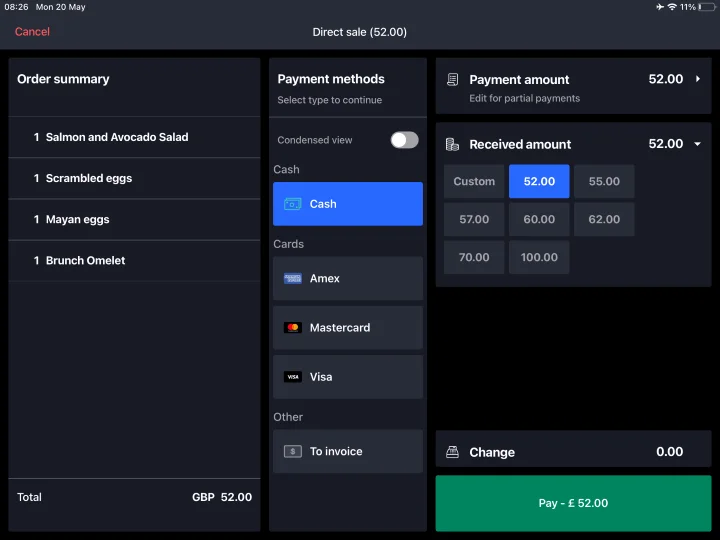
Our user testing of Lightspeed’s interface found it to be smooth, fast and reliable. We would highlight that your staff will need training on the system before becoming fully comfortable using it during rush hour, whereas simple apps like Square and SumUp have much shorter learning curves.
For online orders, there’s Lightspeed’s Order Anywhere module, but note this requires an additional cost on all but the Pro tier. This add-on will generate a mobile-friendly online storefront for click and collect, and delivery for your customers.
Do I need additional hardware?
Lightspeed is built natively for tablets, so you can run it directly from an iPad if that’s all you require (note that Lightspeed can only run on Android tablets on the O-series, with K-series being locked to iOS).
Lightspeed’s iPad-based system prevents you from being locked into an expensive hardware deal for the long-term (like Clover for example), but you will still need an integrated card reader to take payments, which you can purchase directly from Lightspeed.
Lightspeed can also provide accessories like printers and cash drawers, and a stand to turn your tablet into a countertop terminal.
Can Lightspeed integrate with delivery platforms?
The Lightspeed Delivery module allows you to sync your POS with feeds from major delivery platforms, like Uber Ears, Deliveroo and Just Eat. Orders that come in from third-party delivery services will flow directly into your KDS.
- Lightspeed offers the best loyalty tools we've seen in a POS system.
- Lightspeed provides multi-channel 24/7 support, as well as onboarding.
- Lightspeed is adept at inventory management, with ingredient tracking features.
- Unlike Toast and Square, Lightspeed doesn't include automated tip management.
- Lightspeed can only support QR code and mobile ordering through the paid add-on Lightspeed Order Anywhere.
- Lightspeed is tablet-based, so if you want a dedicated countertop terminal then look at Clover or Square instead.
How much does Lightspeed Restaurant cost?
| Pricing | |
| Software | Basic: £79 + VAT per month Core: £149 + VAT per month Pro: £219 + VAT per month |
| Transaction fees | Quote-based |
| Free trial? | Yes |
Lightspeed Restaurant’s entry level tier is a costly £79 + VAT per month, with notable features like click and collect delivery and inventory management only available as paid add-ons, making it a premium option for takeaways.
Also keep in mind that you’ll need to add-on Lightspeed Order Anywhere for mobile ordering (no price is publicly listed), so if your takeaway is a more basic outfit, go with a low-financial-risk option like Square’s free plan.
For high-volume transaction takeaways that are heavily invested in building a sophisticated, multi-tier loyalty programme to encourage a strong customer base, Lightspeed is a strong option.
I found Lightspeed to be fast, smooth and efficient. In general it feels like a very reliable bit of kit. The loyalty features, in particular, really stood out as dense and sophisticated.
How to choose the right POS system for your takeaway business
When choosing your takeaway POS system you need to balance transaction volume against the core software features, like built-in delivery integrations and the KDS:
Suitability for your specific operation
If you run a medium or larger sized restaurant, you’ll need a more advanced POS to support your needs, like Toast or Lightspeed Restaurant, whereas smaller collection or delivery-only eateries will need a budget-friendly POS, like SumUp or Square.
Just ensure your POS system is able to funnel both your walk-in and online orders into the same workflow, or this could lead to confusion and bottlenecks.
Must-have features
Takeaway POS systems will need mobile ordering and a KDS, so your front of house staff can seamlessly communicate orders to the kitchen staff.
Online presence
Having an online presence will also be important for takeaway businesses, so be on the lookout for providers that also offer the capacity to build a website, such as Square Online.
Integration with delivery apps
You don’t want your staff wasting time having to manually retype orders, so ensure your POS can seamlessly connect to online delivery apps. Some need to do this via an aggregator app, which will have an additional cost attached, so ensure you have budgeted for this.
Transaction fees
If your monthly transactions are relatively low, you’re better off starting out with a free or low-cost plan with average transaction fees but, if you’re taking in a high volume of monthly sales, then you’ll be better suited to a paid-monthly plan that will unlock lower transaction fees, like SumUp’s Payment Plus plan.
User-friendliness
Takeaway businesses in particular will need an easy-to-use system to keep hot meals moving out the door at a brisk pace, especially as staff turnover is frequently high in a takeaway businesses. So, you need a system with a short learning curve, like Square.
Options to scale and grow
Look out for POS systems that can support growth, so you don’t have to go through the hassle of switching platforms and getting to grips with a whole new ecosystem if you expand to a multi-site business.
Free plans
While no POS is ever truly free — you’ll still need to pay transaction fees — there are options out there for pay-as-you-go style POS options. Square was our number one choice for a free POS system.
Early-stage takeaways will be able to operate on a free plan, but high-volume businesses will find the advanced software and reduced transaction fees will be worth the cost investment.
Free trials
You should also keep your eyes peeled for POS systems that offer free trials, so you can test them out for yourself before making any financial commitments.
Read next: How to start a takeaway business from home
How we test takeaway POS systems
Our independent evaluation analysed 11 top POS systems, testing them across 37 subcategories, to provide data-backed recommendations for small business owners.
This consisted of a mix of data analysis and actual hands-on user testing, carried out in our Startups offices in London. We conducted hands-on testing of available systems as recently as May 2026.
Our testing framework was based on six criterion, with each given an appropriate importance weighting, and we recently worked with our head of research to adjust these weightings to ensure they are as relevant as possible in 2026:
- How feature-rich is the software? (35%): we researched the crucial takeaway features, including how the platform handles mobile and QR code ordering, the extent of the KDS, inventory management, menu creation, tip management, how accessible sales reports are, and the extent of third-party apps you can connect to the POS for ordering and delivery.
- What additional hardware do I need? (20%): we investigated if the platforms provide a separate KDS (the actual device, not the software), the customer display options on the POS terminal, the portability of the terminals, the display screen quality and the range of accessories.
- Is the platform easy to use? (20%): we conducted actual hands-on user testing, to find out how user friendly the POS system is when rapidly firing and adjusting orders, to determine the learning curve for staff.
- Can I access help and support, and at what hours? (10%): we analyse what avenues of support are available, including phone support, email, live chat, forum, social media, and the accuracy of the knowledge centre.
- What’s the total cost of the system? (10%): we researched the monthly costs of the POS, if there are upfront costs, the transaction fees and hardware pricing, to see if the system is a good deal.
- Does the POS system have a good brand reputation (5%): we also researched competitor reviews and online comments, and then combined these with the thoughts of our own participants, to gauge how likely people are to recommend the POS system.
Jump back up to any of our reviews:
- Best takeaway POS systems: comparison table
- 1. Square: best overall takeaway POS system
- 2. Clover: best premium terminals for rapid checkouts
- 3. SumUp: best for small takeaway counters
- 4. Toast: best for very high-volume takeaways
- 5. Lightspeed Restaurant: best for encouraging repeat orders
- How to choose the right POS system for your takeaway business
- How we test takeaway POS systems
- Verdict: which is the best POS system for takeaway businesses?
Verdict: which is the best POS system for takeaway businesses?
As a result of my most recent hands-on testing process in May 2026, I determined Square to be the best takeaway POS system, thanks to its excellent ease-of-use, which means staff can get trained up incredibly quickly. Square also keeps costs low with a contract-free plan and reasonable set transaction fees.
Startups.co.uk is reader-supported. If you make a purchase through the links on our site, we may earn a commission from the retailers of the products we have reviewed. This helps Startups.co.uk to provide free reviews for our readers. It has no additional cost to you, and never affects the editorial independence of our reviews.


