
A merchant account is your golden ticket to accepting card payments. This is our jargon-busting guide to help you pick the best merchant account for your business
Startups.co.uk is reader supported – we may earn a commission from our recommendations, at no extra cost to you and without impacting our editorial impartiality.
A merchant account is a specialised business holding account required to accept and process card and contactless payments before funds transfer to your bank account.
Having a merchant account is essential if you want your business to start processing card payments, and with so many providers available to choose from, it can be difficult to find the cheapest, most suitable merchant account for your business needs.
Below, we break down merchant accounts for small business owners, how they work, and inform you of everything you need to know so you can stand the best chance of being accepted for an account.
How do you need to take payments?
Compare Costs- Merchant accounts allow your business to accept and process payments from debit cards, credit cards and contactless payments.
- The main fees you’ll encounter are transaction fees, recurring & scheduled fees, and incidental & penalty fees.
- The four types of merchant accounts are aggregators, ISO merchant accounts, high-risk merchant accounts, and internet merchant accounts.
- While aggregators give you instant approval, dedicated merchant accounts can take days or even weeks to set up.
- To get approved for a merchant account, you must have a regulatory status, low financial risk, operational legitimacy, and be fully registered in the UK.
In this guide, we'll cover:
What is a merchant account?
A merchant account is a specialised business account that allows you to accept and process electronic debit and credit cards, as well as contactless payments.
When a customer uses their card to pay, the money doesn’t go straight into your regular business account. Instead, it temporarily sits in the merchant’s account while the payment gateway verifies and processes the transaction.
Approved funds automatically transfer to your business bank account within one to two business days, or instantly with select providers like PayPal.
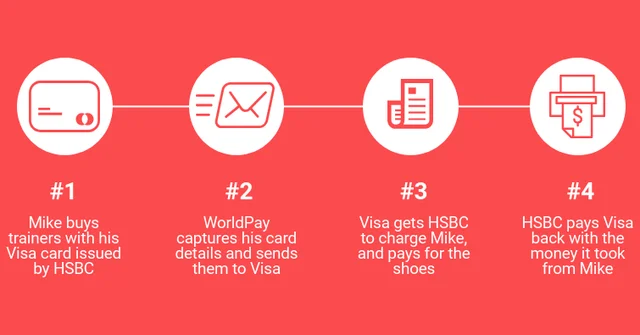
Source: Startups
A report by LINK found that 46% of in-person transactions are still cash-based, particularly in independent retail, cafes and pubs, convenience stores and launderettes.
However, cash usage is still expected to decline over the next few years, as UK Finance predicts it will decline and account for only 4% of all UK payments in 2034.
What merchant account fees do you need to pay?
Merchant account fees consist of three primary changes: transaction fees, recurring monthly software/hardware costs, and incidental penalties like chargebacks.
Here’s a breakdown of the three main merchant account fees you’ll encounter:
1. Transaction fees
Each time a customer uses their card, you’ll pay a fee. This is usually a percentage of the sale, as well as a per-transaction charge (1.5% + 20p, for example). Transaction fees are actually made up of three parts, which are:
- Interchange fee: the percentage that goes directly to the card-issuing bank (such as HSBC or Barclays)
- Assessment fee: a small percentage that goes directly to the card network (like Visa or Mastercard)
- Processor markup: the cut taken by your merchant account provider for facilitating the transaction
2. Recurring and scheduled fees
Recurring and scheduled fees refer to the flat costs of keeping your merchant account active and your hardware running, regardless of how many sales you make. These include:
- Monthly statement/service fee: a monthly fee which ranges from £2-£40 for account maintenance and customer support.
- Terminal rental: if you have a physical retail store, you’ll pay a monthly lease for the card machine hardware.
- PCI compliance fee: a fee that’s charged to ensure your business complies with Payment Card Industry data security standards.
3. Incidental and penalty fees
Incidental and penalty fees are charges that only apply under specific circumstances. For example:
- Chargeback fee: if a customer disputes a charge and their bank forces a reversal, you will be hit with a penalty fee (usually £15-£25 per instance) to cover the administration costs.
- Minimum monthly fee: some providers require you to hit a minimum amount of transaction volume each month, and if you don’t, they’ll charge a top-up fee to meet that minimum threshold.
For more information on this, you can visit our page on the best payment gateways.
There are many merchant account costs your business may face, and it can be tough to get your head around all the charges involved.
To help, we’ve published an extensive guide to merchant account and credit card processing fees so you can calculate how they may impact your business.
What are the different types of merchant accounts?
There are four types of merchant accounts – aggregate merchant accounts, ISO merchant accounts, high-risk merchant accounts, and internet merchant accounts. Here’s a breakdown of each one, what they entail, and their pros and cons.
Aggregate merchant accounts
An aggregate merchant account enables multiple businesses to process card transactions under a single shared master account without requiring an individual Merchant ID (MID).
Instead of getting your own dedicated merchant account from a bank, you essentially “rent” a piece of a large master account owned by a third-party company.
Some famous examples of aggregate merchant accounts include PayPal, Square, Stripe, and SumUp.
- Instant setup, as you're onboarding onto an existing account
- No monthly fees, as most providers operate on a pay-as-you-go model
- You usually pay one fixed percentage per transaction
- Lower transaction limits, which isn't ideal for scaling businesses
- Highly sensitive security systems, which could lead to account freezes or holds
- Heavily automated customer support, making it difficult to speak to a human
Frozen funds, delayed payouts or account terminations are often automated initially and may occur without warning, as providers are responsible for managing financial and compliance risks across their entire platform.
Businesses affected by a freeze or termination can usually resolve the issue by contacting the provider’s risk or support team, requesting details about the restriction, and providing relevant documentation, such as:
- Proof of identity
- Business registration documents
- Invoices
- Supplier agreements
- Delivery records
- Refund policies
- Transaction explanations
- Evidence that disputed payments are legitimate
If an account cannot be reinstated, businesses may need to apply for a dedicated merchant account or move to another payment provider.
ISO merchant accounts
An ISO merchant account is a dedicated merchant account provided by an independent sales organisation (ISO).
ISOs are third-party companies that act as official brokers for major banks like Barclays and NatWest. Major banks partner with ISOs like Worldpay and Clover to manage sales, onboarding, and customer support for dedicated merchant accounts.
With an ISO merchant account, you get your own dedicated Merchant ID (MID), meaning your business has its own direct relationship with the payment processing network.
- Offer tailored and cheaper rates for high volume transactions (unlike aggregators that charge a flat rate)
- As ISOs approve your account before starting, the risk of sudden account freezes or fund holds is incredibly low
- Dedicated human support, such as your own account manager or direct customer phone line
- Longer setup time, as approval can take from a few days to a couple of weeks
- ISO accounts often come with terms and may charge early termination fees if you leave
- Even if you make zero sales, you'll still be charged fix monthly overheads
High-risk merchant accounts
A high-risk merchant account is a specialised payment processing account made for businesses that banks and credit card networks consider to have a high risk of financial loss, legal issues, or fraud.
Businesses with high chargeback risks or operating in regulated industries must use specialised high-risk merchant accounts rather than standard bank accounts. Instead, you would have to use a specialised high-risk provider.
Businesses considered to be “high risk” are:
- Travel & hospitality: airlines, cruise lines, and tour agencies (services are paid for far in advance, leaving a large window for cancellations and business bankruptcy).
- Regulated goods: CBD products, e-cigarettes/vape shops, alcohol, and firearms.
- Entertainment & gaming: online gambling, casinos, adult entertainment, and dating apps.
- Subscription models: monthly subscription boxes or SaaS software (customers often forget they signed up and file chargebacks rather than cancelling),
To see whether your business may be high risk, review our in-depth analysis of high-risk merchant accounts.
- As high-risk processers expect volatility, your account is stable nd won't be randomly terminated over a few disputes
- Often allow chargeback ratios before taking disciplinary action (depending on payment network provider)
- Provide robust fraud prevention systems, including 3D Secure (3DS2) protocols, AI fraud screening, and chargeback mitigation tools
- Have much higher transaction fees, which can be from 2.9% to 10%+ per transaction
- The processor will hold a percentage of your gross sales in a secure holding account for a rolling period (usually 90-180 days) before releasing it to you
- Usually have longer settlement periods (often 7-14 days)
Internet merchant accounts
An internet merchant account (IMA) – also known as an ecommerce merchant account – is a business bank account designed specifically for processing online transactions.
Unlike a standard retail merchant account, which handles card payments that are physically tapped, swiped or inserted into a reader, an internet merchant account handles Card-Not-Present (CNP) payments over the web.
You can get an internet merchant account either through an all-in-one provider (such as Stripe, PayPal, and Shopify Payments) or a traditional high street bank or ISO and connect it to a separate gateway (like Authorize.net or Opayo).
For businesses selling internationally, an internet merchant account may also support multi-currency payments, allowing customers to pay in their local currency while the merchant receives settlement in a chosen currency.
However, international card sales can involve additional costs, including currency conversion fees when a transaction is converted between currencies. You may also be subject to cross-border processing fees, which typically apply when the customer’s card is issued in a different country from the merchant’s acquiring account.
- Allows your website to accept payments from all over the world 24/7
- Lets you easily plug in multiple digital payment methods at checkout, including Apple Pay, Google Pay, Klarna, and PayPal
- Advanced ecommerce fraud protection, like Address Verification Systems (AVS), CVV checks, and 3D Secure 2 (3DS2) protocols
- Higher transaction fees, as CNP transactions are riskier for banks
- More vulnerable to "friendly fraud" chargebacks, with a high number of these leading to penalisation or account shut down
- If you experience technical problems (like your payment gateway crashing), your ability to take money stops
For support with finding a merchant account that suits your business’s needs, we also have a detailed review of the best merchant account services and credit card processing companies in the UK.
How do you get a merchant account?
The exact steps for getting a merchant account depend on whether you choose an all-in-one aggregator (like Stripe or Square) or a traditional dedicated account through a bank or ISO.
Either way, here are the typical steps involved in obtaining a merchant account.
1. Choose the right kind of provider
First, you’ll need to decide which model best fits your business size and sales volume. Here’s how you should decide:
- Choose an aggregator if you are a startup, small business, or sole trader processing under £5,000-£10,000 a month, as they offer instant approval and no monthly fees.
- Choose a dedicated merchant account if you are an established business with high sales volume (over £10,000 a month) and want lower and tailored transaction rates.
2. Gather your business documents
If you’re applying for a dedicated merchant account, the provider’s underwriting team needs to review your business to assess financial risk. In this case, you will need the following documents ready:
- Business identification: your company registration number (if you are a limited company), your unique taxpayer reference (UTR), and business address.
- Personal ID: a government-issued photo ID (like a passport or driver’s licence) for the business owners.
- Financial statements: 3-6 months of corporate bank statements and processing history (if you’re switching providers).
- Business model details: an estimate of your average transaction size and expected monthly card sales volume.
3. Ensure your business is compliant
For online stores, your website must be fully functional. This means it must clearly display your terms and conditions, return policy, privacy policy, contact details (email and phone), and delivery timeframes.
For physical retail businesses, you may need to provide a photo of your storefront, inventory, or a copy of your commercial lease.
4. Complete underwriting and technical setup
If you’re choosing a dedicated merchant account, the provider’s underwriting team will review your application, which often takes around 2-7 business days.
Once approved, you’ll receive your unique Merchant ID (MID). For physical stores, the provider will ship you your card terminals, which plug into your internet or connect through Wi-Fi/SIM.
For online sales, you’ll receive API keys or a plugin to connect your new payment gateway directly to your website’s checkout page.
After a few test transactions clear successfully, you are officially ready to do business with your new merchant account.
How do you qualify for a merchant account?
To be eligible for a merchant account, you must prove to a payment processor or acquiring bank that your business is legitimate, low-risk, and legally compliant. Here’s a quick breakdown of what makes a business eligible for approval:
- Legal and regulatory status: this includes being a legally recognised entity, having a business bank account, and having the right permits if you operate in a regulated industry (like alcohol, CBD, and gaming).
- Low financial and credit risk: proof of a strong business credit score or low chargeback history (under 1%).
- Operational legitimacy and transparency: a fully live business website, a clear explanation of your products, and your pricing strategy.
- Location: your business must be legally registered in the UK, where the payment processor officially operates.
Even if you have a few black marks on your credit report, it may still be possible to get a merchant account.
In these cases, you might face slightly higher charges, but once you have a good track record behind you (and healthy sales), you can always renegotiate your merchant account fees.
What to do if your merchant account application is rejected
If your merchant account application is rejected, the first step is to understand the reason for the decline.
Payment providers may reject applications due to factors like industry risk, insufficient trading history, poor credit indicators, incomplete documentation, high projected transaction volumes, previous payment processing issues, or concerns about chargeback exposure.
If your business is declined, consider the following:
- Review and improve the application: check that all submitted information is accurate and provide additional documentation that proves legitimacy, including supplier invoices, proof of fulfilment processes, financial statements, compliance certificates, and customer support procedures.
- Fix any risk issues: adding clear refund and contact policies, reducing chargebacks, and putting stronger fraud checks in place can make your business more attractive to providers.
- Apply with a specialist high-risk payment provider: if you’re operating in a high-risk industry, then specialised high-risk merchant accounts are designed for businesses with more exposure to fraud, disputes, or regulatory requirements.
- Consider alternative payment solutions: some businesses start with payment platforms or other payment solutions while they build a track record before applying for a traditional merchant account.
If you have any past bankruptcies or late payments on your credit report, just write to a credit reporting agency such as TRW Credit Services or Experian, which can have any resolved blotches removed from your record to boost your credit rating.
Are you interested in opening a merchant account?
Merchant accounts allow you take payments in ways that improve efficiency across your business. The best way to find the right deal is to speak to suppliers that understand your needs. We can help with that – simply complete our quick and easy form and we'll connect you with relevant providers.
Final thoughts
A merchant account is an essential part of accepting card payments, helping businesses process transactions securely before funds are transferred to their bank account.
While the right solution depends on your business model, sales volume and payment channels, understanding the different types of merchant accounts, the costs that come with them, and the approval process will help you make a more informed decision.
In the end, it comes down to comparing providers carefully and choosing a solution that best matches your current needs and future growth plans, as this will help you create a reliable payment experience for customers while supporting your business’s long-term success.
Startups.co.uk is reader-supported. If you make a purchase through the links on our site, we may earn a commission from the retailers of the products we have reviewed. This helps Startups.co.uk to provide free reviews for our readers. It has no additional cost to you, and never affects the editorial independence of our reviews.


