So you’ve decided to take the leap to becoming self-employed – congratulations! Here’s what you need to know about registering with HMRC.

Self-employment is on the rise in the UK, with 4.39 million people starting a business this way as of Q3 2025.
To register as self-employed in the UK, you must notify HMRC via the GOV.UK portal by October 5th in your business’s second tax year to avoid penalties.
It also means that you are responsible for handling your own tax, National Insurance and student loan payments, plus keeping track of your expenses.
If you’re considering making the switch to self-employment, it’s important to understand how this works with HMRC and what will be expected from you.
In this article, we’ll explore how and when to register a self-employed business, what to do if you’ve gone down the limited company route (and incorporation with Companies House), and next steps once your registration is complete.
Most business ideas never make it to open for business. Yours will.
The Startups Business Toolkit gives you everything to get found, take bookings, and get paid, all in one place.

- When becoming self-employed, you should consider whether you’ll operate as a sole trader, in a partnership, or as a limited company.
- You’ll need to register as self-employed with HMRC if you earn over £1,000 in a tax year.
- Registration involves creating a Government Gateway account, completing the HMRC form, and receiving a Unique Taxpayer Reference (UTR).
- You must register for self-assessment and Class 2 National Insurance by 5 October following the end of your first tax year.
- Self-assessment tax returns are due online by 31 January every year, and filing late can result in a £100 fine.
- From April 6 2026, self-employed individuals will be required to keep digital records and send regular updates to HMRC under Making Tax Digital (MTD).
- Do I need to register as self-employed?
- When do I need to register as self-employed?
- How to register as self-employed with HMRC (3-step guide)
- Other ways to register
- Financial requirements as a self-employed business
- Should I register as a sole trader or a limited company?
- Can I register as self-employed while working a full-time job?
- Taking the leap
When do I need to register as self-employed?
You’ll need to register as self-employed as soon as you decide that’s the direction you want to go in. The next step will then be to submit your working status to HMRC, the UK’s tax authority, ready for your self-assessment.
Self-assessment refers to HMRC’s system of collecting income tax – you should register for self-assessment and Class 2 National Insurance payments by no later than the 5th October in the second tax year of your business operating.
For example, if you started working as self-employed on 1st February 2025, you would need to register as self-employed with HMRC by 5th October 2026. If you don’t, you could be fined – and of course, that’s not ideal.
Failing to register as self-employed on time could result in penalties from HMRC.
If you miss the deadline for Self-Assessment, you’ll automatically be fined £100, even if you don’t have tax to pay or if you pay the tax on time.
Other charges include:
- £10 per day after three months
- 5% of the tax due or £300 after six months
- 5% of the tax due or £300 after 12 months
How to register as self-employed with HMRC (3-step guide)
The process of how to register as self-employed involves signing up for self-assessment and receiving a Unique Taxpayer Reference (UTR).
This part can feel scary and overwhelming, but it’s really quite easy. Follow the steps below, and you’ll be ready to go in no time.
Step 1: make a Government Gateway account
On the gov.uk website, set yourself up with a Government Gateway account – this will become your login details for your self-assessment. You’ll then need to enter your email address after which you’ll be sent a user ID so you can complete the next steps.
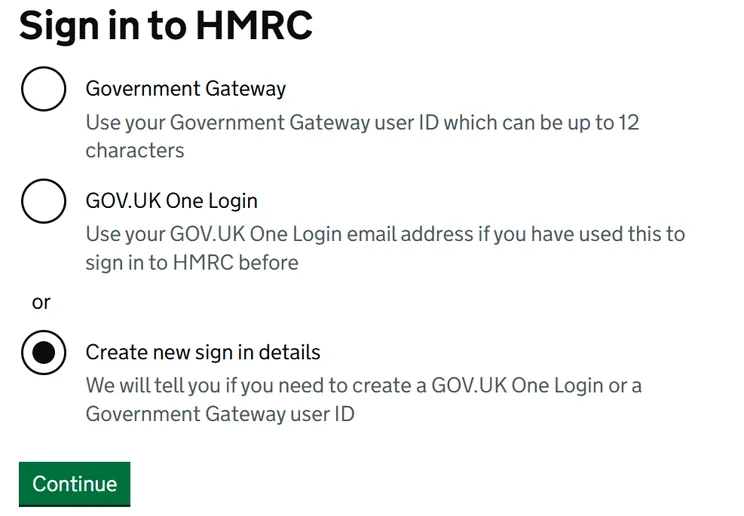
Select “create sign in details” to set up your Government Gateway account (Source: Startups.co.uk)
Step 2: complete your registration
Once you receive your user ID, sign in and complete the form to register as self-employed. You will need to add personal details and key business details to do this, like the date you started trading, and the type of work you’ll be doing.
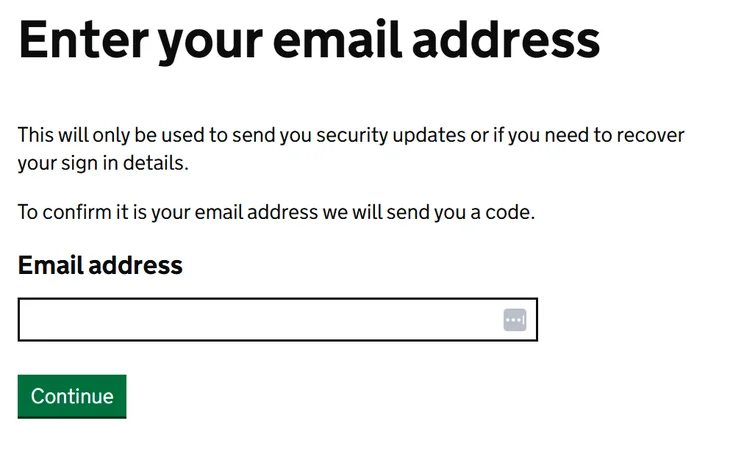
You will need to enter your email address to receive your user ID (Source: Startups.co.uk)
Step 3: get your UTR number
Once the form has been completed, your 10-digit UTR number will be delivered in the post via an official letter from HMRC. Keep this safe and jot it down in a few places for safekeeping – you’ll need it to complete yourself-assessment tax returns.
Congratulations – you’ve officially become self-employed!
Making Tax Digital (MTD) is a UK Government initiative that is set to become mandatory from 6 April 2026. From this date, businesses and freelancers will be required to keep digital tax records and submit tax information to HMRC using approved accounting software (rather than paper records).
For self-employed individuals, MTD means keeping records of income and expenses in digital form and sending updates to HMRC throughout the year. Instead of one annual self-assessment return, you’ll need to submit quarterly updates. However, you’ll still have to submit a final declaration at the end of the tax year to confirm everything.
MTD is being introduced in waves. The first wave, which will come into effect on 6 April 2025, will only apply to those whose gross annual income for the tax year 2024-2025 exceeded £50,000.
Other ways to register
If registering as self-employed online isn’t convenient for you, you can also do this via post and phone:
- To register via phone, call HMRC’s self-employed helpline on 0300 200 3310 and be ready with personal details like your business name and address, National Insurance number and previous tax information.
- To register via post, download a SA1 form from HMRC’s website. Complete it and post it to the address detailed on the form.
Financial requirements as a self-employed business
Once registered as self-employed, it’s important to keep track of all the invoices you’ve issued to customers, as well as any business-related expenses. This information is crucial to completing your self-assessment tax returns accurately.
The deadline for sending a self-assessment tax return online is 31st January every year. When the form mentions ‘payments on account’, these are payments that are made towards your next tax bill and help spread the cost of your tax by making payments in two instalments – each payment is half of the tax you owed last year. These payments are due by midnight on 31st January and 31st July.
If you struggle to make the payment owed in one lump sum, you can contact HMRC directly to set up a payment plan.
How you complete your tax return is totally up to you – you can either choose to do it yourself with or without the help of accounting software, or you can hire an accountant to fill it out on your behalf.
Either way, it’s important to keep a detailed spreadsheet of your expenses, invoice dates and fees as these are essential for self-assessment tax returns.
Should I register as a sole trader or a limited company?
When becoming self-employed, you should consider whether you want to operate as a sole trader, in a partnership, or as a limited company. Let’s look at what each of these means.
Sole trader
A sole trader is what it says on the tin – they’re the sole owner of the business and don’t have any employees. This is the simplest type of self-employment and is easy to set up, but also has unlimited liability as sole traders aren’t viewed as a separate entity by UK law. This means that if the business gets into debt, the business owner is personally liable.
In a partnership
Being self-employed as a partnership is the description given to two or more people agreeing to join in a business venture together with a view to making a profit. In most cases, all partners own the business equally and are responsible for any profits or liabilities on an equal basis.
This structure means that the owners don’t have the traditional director and shareholder roles in the same way that limited companies do. However, every partner is liable for the partnership debts.
Limited company
A limited company is a type of self-employed business structure with its own legal identity. Separate from its owners (shareholders) and managers (directors), it is governed by UK company law. A limited company has limited liability, meaning that, unlike sole traders and partnerships, it is a legal entity separate from both its shareholders and directors.
Such businesses are more complicated to set up and run, often requiring specialist advice from external parties like solicitors, and one major downside is that this can be expensive. Limited companies must be incorporated at Companies House, the public registry, and must file their accounts annually.
Head to our handy guide on choosing the right company structure and which may work best for you and your business plans.
Can I register as self-employed while working a full-time job?
You can register for self-employment even if you’re working a full-time job. Running a side hustle or “moonlighting” outside of your regular job is completely legal and many people do it, but you must still register and declare any income you earn.
Income from your full-time job is usually taxed automatically through the Pay As You Earn (PAYE) scheme. Your employer deducts income tax and National Insurance from your salary before you’re paid, using your tax code. You don’t need to take any action here, as HMRC receives the information directly from your employer.
When earning money from a side hustle or self-employment, you are responsible for declaring this income yourself. This income is reported through your self-assessment tax return, where you declare your earnings and deduct any allowable business expenses.
For tax purposes, your self-employed profits are added to your PAYE salary to work out your total taxable income for the year. Income tax is then charged at the usual UK rates (20%, 40%, or 45%), depending on your total income.
One profile. 50+ directories. Show up everywhere customers search.
Create your listing once and it's automatically shared across 50+ directories. One update, everywhere at once.
Taking the leap
Becoming self-employed is a huge, yet exciting, step in a person’s career, and once you understand how to register as self-employed, you can focus on running your business and staying on top of your tax responsibilities.
Having a clear understanding of what is involved and the expectations from HMRC is important, but once you know this, it’s a simple process to become registered.
Remember, you must file a tax return every January and be sure to keep an accurate log of all invoices and expenses to help you fill this out – although time-consuming, it’s much easier to do this throughout the year than to dig out all of your bank statements and fill them out in one go.
For more advice on being self-employed, check out our guide to essential workers’ rights contractors.

Kirstie Pickering – business journalist
Kirstie is a freelance journalist writing in the tech, startup and business spaces for publications including Sifted, UKTN and Maddyness UK. She also works closely with agencies to develop content for their startup and scaleup clients.


